

Rediscover Mount Fuji: Sacred Mountain, Gateway to Renewal
Rising as Japan’s highest peak, Mount Fuji has shaped a remarkable landscape through its volcanic form and the pure spring water that flows from its slopes. Over thousands of years, eruptions and lava flows created a terrain that now supports the serene Fuji Five Lakes, the mysterious depths of Aokigahara Forest, and countless springs whose clear, cold water sustains both nature and human life. This abundance of water has quietly linked mountain, forest, and settlement into a single, living system.
Viewed from different sides, Mount Fuji reveals distinct characters. In Yamanashi, broad lake basins and fertile foothills foster agriculture, weaving traditions, and winemaking. In Shizuoka, the mountain descends toward the sea, shaping coastal cultures and refined brewing practices that draw on pristine groundwater. Across both regions, Mount Fuji has long inspired faith and creativity, giving rise to shrines, pilgrimages, and artistic expression that reflect reverence for its overwhelming presence.
Recognized for this rare union of natural beauty and cultural meaning, the area has been designated as part of Fuji-Hakone-Izu National Park and inscribed as a UNESCO World Cultural Heritage site. To visit Mount Fuji is to encounter it not only as an icon seen from afar, but as a place felt through the senses—the chill of spring water in the hand, the hush of deep forests, and the commanding silence of the mountain itself. Spending time at its base offers a chance to rediscover the essence of Mount Fuji, beyond its image, through direct and memorable experience.


Sacred Peaks and Living Traditions around Mount Fuji
For centuries, Mount Fuji has been revered as a mountain where the divine resides, inspiring awe, devotion, and disciplined practice. This sacred view gave rise to a rich lineage of mountain worship, from Shugendo asceticism to the popular faith of Fuji-ko, whose followers believed that climbing or venerating the mountain brought spiritual renewal. Alongside them flourished the culture of Oshi—Shinto priests who hosted pilgrims, provided them with spiritual guidance, led rituals, and maintained networks of belief that connected everyday life with the sacred peak.
Walking the foothills today, this living heritage remains tangible. On both the Yamanashi and Shizuoka sides, shrines, temples, and approach paths trace routes once taken by pilgrims. In former Oshi towns, preserved streetscapes and lodgings such as KAKURINBO offer encounters with prayer, seasonal rites, and festivals that reveal how faith shaped communities over generations. Here, Mount Fuji is not a distant symbol, but a constant presence woven into daily rhythms.
At the same time, Mount Fuji has long been an enduring source of artistic imagination. From Hokusai’s iconic ukiyo-e woodblock prints to contemporary photography, art, and craft, creators have returned again and again to its symmetrical form and shifting moods. Experiences such as the Mount Fuji FUGAKU Stay and Hokusai Package connect specific places and works, showing how the mountain continues to inspire new expressions across eras.
This sacred landscape also nurtures a refined modern sensibility. Pure water and fertile land support ingredients that are elevated in contemporary gastronomy at restaurants like Restaurant sai 燊and Maison KEI, where local nature is reinterpreted through sophisticated technique. Elsewhere, dining experiences such as HAMANASHI HOUSEBOAT, a floating restaurant on Lake Kawaguchi, offer intimate perspectives on waterside ecosystems shaped by the mountain.

HAMANASHI HOUSEBOAT
Together, these elements reveal the Mount Fuji region as a place where ancient belief and modern lifestyle intersect—a multifaceted world in which sacred tradition, creative expression, and contemporary living continue to coexist beneath Japan’s most revered peak.
Water, Forest, and Sky: Retreats at the Foot of Mount Fuji
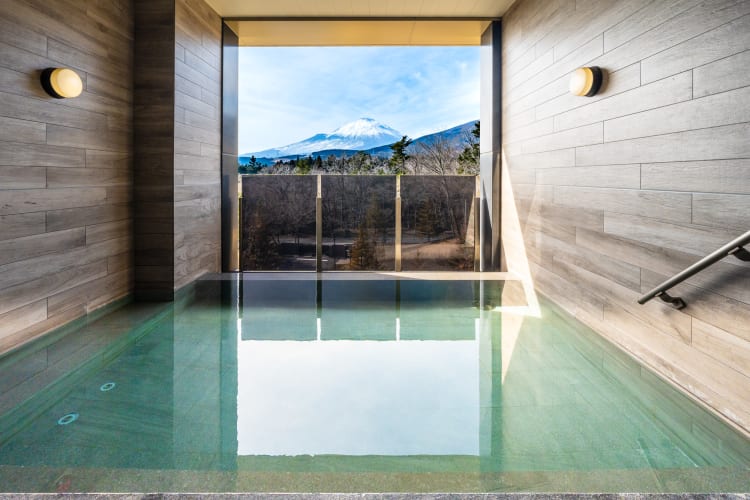
At the foot of Mount Fuji, retreats unfold as spaces where water, forest, and sky come into quiet balance, offering restorative experiences that go beyond simple accommodation. Here, traditional aesthetics merge seamlessly with contemporary luxury. GAKUROKU SUIEN, a house with over 200 years of history, and GORA KADAN FUJI, a modern ryokan rooted in Japanese cultural traditions and nature-based wellness, reinterpret Japanese architectural beauty through refined materials, open sightlines, and serene gardens, creating an atmosphere of calm sophistication.From guest rooms and open-air baths, the presence of Mount Fuji is felt as a constant, grounding force that is sometimes revealed in full, and sometimes sensed through light, wind, and silence.

Fuji Seiran
Immersion in nature takes center stage at stays like Hoshinoya Fuji, Fufu Kawaguchiko, and Fuji Seiran, where guests are invited to slow down amid towering forests, lakeside mist, and expansive skies. Floor-to-ceiling windows and private terraces frame the mountain and its changing moods, encouraging a deep connection with the surrounding landscape. These settings allow visitors to behold Mount Fuji not as a postcard image, but as a living environment that shifts with the hour and season.
Fuji Speedway Hotel
The region also embraces modern themes. At the Fuji Speedway Hotel, motorsports heritage and contemporary design intersect, offering a dynamic contrast to the mountain’s timeless stillness with the hotel’s views of the famous racetrack. Meanwhile, around Minobu, shukubo temple lodgings such as KAKURINBO provide a different kind of retreat, where sutra chanting and seated meditation invite guests to reset both mind and body through spiritual practice.
On the Shizuoka side, stays highlight cuisine shaped by Suruga Bay’s seafood and pristine spring water, as seen at places like Numazu Club, paired with walks along forest trails.
Crafted by Clear Waters: Textiles, Tea, Wine, and Fermentation
The clear water and cool air of Mount Fuji shape not only the landscape, but also the crafts that carry its memory into everyday life. These are objects and flavors meant to be experienced with all five senses, becoming souvenirs not of spectacle, but of place. From wine and fermentation to textiles and dyeing, each creation reflects the quiet power of Fuji’s natural environment.
On the Yamanashi side, centuries of grape cultivation tell a story deeply rooted in the land. The region’s vineyards thrive in Mount Fuji’s cool climate and well-drained volcanic soils, conditions that encourage slow ripening and nuanced expression. Fed by pristine spring water, local wines are known for their refined balance and aromatic clarity. Each bottle captures more than taste alone; it distills the rhythms of the seasons, the patience of growers, and a terroir shaped by altitude, temperature, and geology. Drinking these wines becomes an intimate encounter with the land itself.

Across the mountain in Shizuoka, craftsmanship takes tactile form. Traditional textiles and dyeing practices, passed down through generations, reveal another dialogue between nature and human skill. Techniques such as Mikuriya dyeing, which uses spring water to achieve subtle, enduring hues, depend on the area’s cool climate and mineral-rich flows. The resulting fabrics carry a quiet depth in their colors softened by water and textures refined by time, with each piece exemplifying precision and character.

Mikuriya dyeing
