


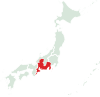























Story Warm Waters & Quiet Landscapes: Japan’s Top 3 Hot Springs of 2025 By JNTO on 12 March 2026
A look at Japan’s leading hot spring towns, suited for family trips that balance relaxation and time together.
Onsen (Hot springs) are an important part of Japanese culture, known for their relaxing qualities and health benefits. For families travelling with children, onsen towns surrounded by nature offer a comfortable and easy-going travel experience away from busy cities.
Now let’s take a look at three onsen that topped Japan’s Top 100 Onsen Ranking List by the Kanko Keizai Shimbun!
1st Place: Kusatsu Onsen, Gunma Prefecture

Kusatsu Onsen has ranked first in Kanko Keizai Shimbun’s ‘Japan’s Top 100 Onsen’ for 22 consecutive years and is considered one of Japan’s three major hot springs. Located in the mountainous region of Gunma Prefecture, it is renowned for its long-standing reputation for high-quality hot spring waters and well-established onsen culture. The town is surrounded by natural scenery and has historically been associated with onsen therapy.

Hot spring water flowing through cooling channels at Kusatsu’s yubatake.
At the centre of the town is the yubatake (hot water field), where large volumes of mineral-rich hot spring water flow through wooden channels before being distributed to bathhouses and ryokan throughout Kusatsu. This system naturally cools the water while preserving its mineral properties and has become one of the town’s most recognisable landmarks.

A yumomi performance, where staff stir the hot spring water with wooden paddles.
Beyond bathing, Kusatsu offers a variety of experiences shaped by its hot spring culture and natural surroundings. Visitors can watch yumomi, a generations-old water-stirring practice originally developed to cool hot spring water without dilution and allows the minerals to circulate through the bath.
With its consistent top ranking, abundant hot spring supply, and distinctive townscape, Kusatsu Onsen continues to be regarded as one of Japan’s leading hot spring destinations.
Find out more about Kusatsu Onsen:
https://www.japan.travel/en/spot/1518/
2nd Place: Gero Onsen, Gifu Prefecture

Gero Onsen was ranked second in Kanko Keizai Shimbun’s 2025 ‘Japan’s Top 100 Onsen’ and is widely regarded as one of the country’s most established hot spring towns. Located in central Gifu Prefecture along the Hida River, the town is known for its scenic river valley setting and long history as a hot spring destination.


Go on a relaxing stroll around Gero, with lanterns lighting the riverside promenade at night.
Also traditionally counted among Japan’s three famous hot springs along with Kusatsu Onsen, Gero Onsen’s clear, alkaline spring water is known for its smooth, gentle feel on the skin and long appreciated for its beneficial effects, leaving bathers feeling soft and refreshed after soaking.

Winter brings a whole new charm to the streets of Gero Onsen.
Gero Onsen’s compact townscape makes it easy to explore on foot, with streets ideal for relaxed walks and photo-taking. Ryokan inns and foot baths are spread across the area, while riverside paths and bridges provide views of the surrounding mountains and changing seasons.
Blending natural beauty, long-standing tradition, and enchanting streets, Gero Onsen offers a soothing escape where time slows, and the rhythm of the river sets the pace of your stay.
Find out more about Gero Onsen:
https://www.japan.travel/en/spot/2033/
3rd Place: Dogo Onsen, Ehime Prefecture

Dogo Onsen was ranked third in Kanko Keizai Shimbun’s 2025 ‘Japan’s Top 100 Onsen’ and is widely regarded as one of the country’s oldest hot spring towns with a history of around 3,000 years! Situated in Ehime Prefecture’s Matsuyama City, it has a history of bathing culture that stretches back centuries and continues to attract visitors interested in a traditional Japanese hot spring experience.

Even in the locker room, the warmth of the hot springs fills the historic bathhouse.
The water at Dogo Onsen is classified as a simple alkaline spring, valued for its mild and gentle characteristics. Its suitability for regular use has played an important role in sustaining bathing practices that are closely connected to everyday life in the region.

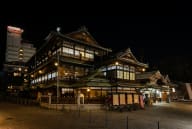
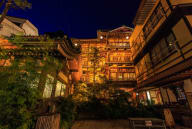
The iconic wooden architecture of Dogo Onsen Honkan at night.
At the heart of the area is Dogo Onsen Honkan, a historic wooden bathhouse that has become a recognisable landmark of Matsuyama. Surrounding the bathhouse is a compact network of streets lined with inns and small local businesses, creating a district that is easy to explore while retaining a strong sense of history.
The presence of both historic structures and daily local activity contributes to Dogo Onsen’s enduring status as one of Japan’s leading hot spring destinations.
Find out more about Dogo Onsen:
https://www.japan.travel/en/spot/821/
The top-ranked destinations, Kusatsu Onsen, Gero Onsen, and Dogo Onsen, each offer a distinct expression of Japan’s onsen culture, shaped by their natural surroundings, local traditions, and long history of bathing. Together, they illustrate the diversity of hot spring experiences found across Japan, from mountain resorts and riverside towns to historic urban districts.
For travellers seeking relaxation, cultural depth, and a slower pace of travel, these onsen towns provide enduring examples of why hot springs remain an important part of Japan’s travel landscape.
Rankings are based on the ‘Japan’s Top 100 Onsen’ (にっぽんの温泉100選), published annually by Kanko Keizai Shimbun, and are determined through votes from tourism and hospitality professionals across Japan.
https://www.kankokeizai.com/index_100sen/
Date of Publication: 12 March 2026
