





































Sustainable Destinations Connecting with Local Life Amid Lush Nature in Amagi and Obuse
A country of numerous climates and a remarkable variety of landscapes, Japan is a dream destination for many outdoorsy travelers. While the island nation has its share of remote wilderness, a notable feature of some of its most exciting nature sites is how close they are to residential areas. This proximity allows visitors to not only enjoy stunning scenery without the need for arduous travel, but also to connect with local communities and get a feel for how residents have adapted their lives to the natural environment.
In Amagi on the subtropical island of Tokunoshima, Kagoshima Prefecture, exploring the lush forests of a World Natural Heritage Site can be combined with a visit to a “bull sumo” stable and a stay in a beautifully renovated traditional house. In Obuse in Nagano Prefecture, visitors have the opportunity to connect with farmers and gardeners while making their way around this picturesque highland town on foot.
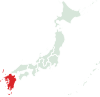
Amagi Town (Kagoshima)


A Subtropical Sanctuary Where Rabbits Roam and Bulls Do Battle
Part of the Amami archipelago just north of Okinawa and most commonly accessed by airplane or ferry from Kagoshima, Tokunoshima draws travelers with its mild climate, distinctive flora and fauna, and vibrant cultural heritage. The town of Amagi on the island’s western side is the starting point for various guided tours and experiences that take you deep into local nature and culture, from a protected forest inhabited by endemic species such as the dark-furred Amami rabbit to the sparring grounds of fighting bulls beloved by the community.
A Majestic Forest, an Elusive Icon
Tokunoshima is part of a UNESCO World Natural Heritage Site that also encompasses the island of Amami Oshima, northern Okinawa Island, and Iriomote Island. Two sections of forest in the island’s hilly interior have been designated special protected zones, entrance to which is restricted in the interest of safeguarding the natural environment.

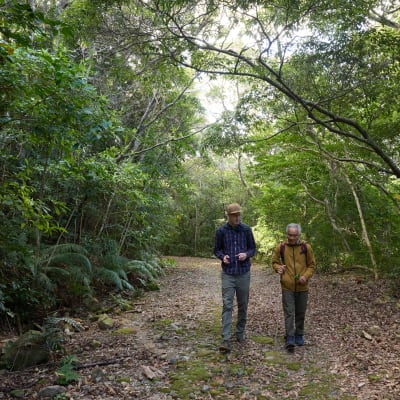
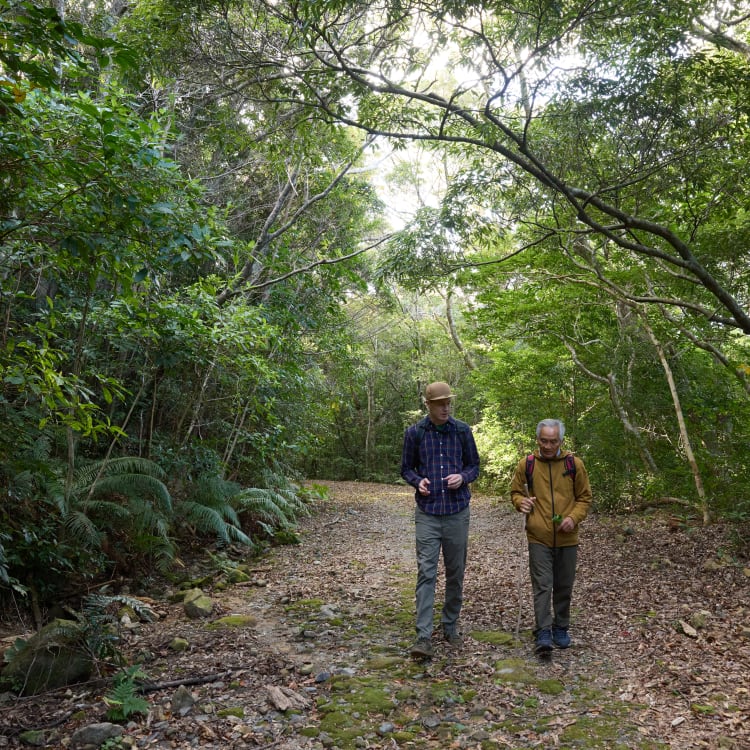
On a hike through the forests of Amagi
In these areas, well-maintained hiking trails take you through the subtropical woodland, past towering Okinawa urajirogashi oaks and hardy chinkapin trees (sudajii). On a fine day, sunlight filters through the foliage and reflects off the ferns covering the forest floor. Somewhere up high, native birds like the Taiwan green pigeon let out their peculiar cries. Strolling amid the greenery while your guide points out various plants and provides background on their many uses in local culture makes for an experience as educational as it is relaxing.
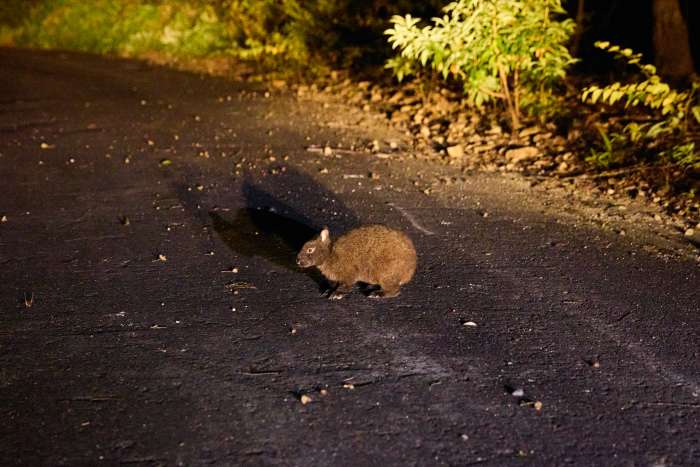
An Amami rabbit
After nightfall, when darkness envelops the forest, out comes the furry animal that has become a symbol of Tokunoshima, seen on everything from road signs to T-shirts and trinkets sold at the airport gift shop. The Amami rabbit, found only on Tokunoshima and nearby Amami Oshima, is a fast runner and not what you’d call easy to spot. Local nature guides, however, are well versed in the rabbit’s behavior and will do their utmost to help you catch a glimpse of the blackish bunny. Nighttime rabbit-spotting tours are conducted in small groups and precautions are taken not to disturb the endangered animals.
Rich biodiversity was one of the outstanding factors cited when Amagi was named among the world’s Best Tourism Villages by UN Tourism in 2024. Another was the town’s protection of its cultural heritage and customs, which can also be experienced in Amagi first hand.
Bulls and Restored Buildings: A Cherished Community Heritage
Togyu or bull sumo is a centuries-old tradition and an integral part of the culture of Tokunoshima. In togyu, two bulls led by their trainers fight each other in a ring until one retreats. There are hundreds of specially trained fighting bulls on the island, and 15 to 20 togyu events, including three title tournaments, take place every year.
Attending a tournament isn’t the only way get a feel for Tokunoshima’s bull-fighting heritage. Some local bull trainers welcome travelers to tour their stables and get up close and personal with the imposing animals, the largest of which weigh over a ton.

Petting a young togyu bull
The trainer will show you how to brush the bulls’ coarse hair with a rake-like metal comb, let you help feed them grass and sugar cane, and perhaps allow you to attend a training session, which can consist of everything from jogging to lifting heavy objects.
Another attractive way to experience authentic island life is to stay the night in a traditional house. On Tokunoshima, five heritage buildings that had been left uninhabited have been carefully renovated and turned into accommodation facilities that combine modern convenience with old-fashioned charm. Known as Denpaku Traditional House, these homes-turned-hotels invite travelers to live like, and among, locals during their stay on the island.

A hut built out of coral stones at a Denpaku Traditional House property in Amagi
Two of Tokunoshima’s five Denpaku Traditional House properties are in Amagi. The facility in the village of Matsubara combines a spacious main building with an Okinawan-style hut built out of coral stones, where guests can relax while enjoying the surrounding greenery. Meanwhile, the secluded Sea Turtle Beach Inn is situated just a few steps from a sandy cove where sea turtles lay their eggs from June to July.
Sustainability Spotlight

Toyomura Yuichi
Certified Eco-Tour Guide
Born and raised on Tokunoshima, eco-tour guide Toyomura Yuichi draws on decades of insight into local nature and culture when leading travelers through the protected forests of Amagi. “The attractiveness of exploring [local nature] is what I most hope to convey to visitors,” he says. “Going into the mountains is a great way to get in touch not only with the environment, but with culinary culture and local traditions that have been upheld here for generations.”
Whether he’s scouring the woods at night to offer guests a peek at the Amami rabbit or taking a group of adventurers up narrow paths to some of his favorite spots in the forest, Toyomura makes it easy for travelers to experience the natural beauty of the island at a leisurely pace. “I like to show guests the forest as a place for play,” he says, “as well as a rejuvenating place that offers calm and peace of mind.”

Toyomura considers Tokunoshima’s compact size and small-scale approach to tourism some of its greatest strengths, and he’s optimistic about the island’s prospects as a sustainable destination. “This is a small island, but there’s a lot to experience: history, traditional culture, distinctive nature, and tasty food,” he says. “In terms of tourism, we’re still standing at the starting line in some ways. From here on, I hope we can focus on recognizing visitors’ preferences better while providing them with the experience of exploring Tokunoshima like locals. That, I think, is the best way to preserve the island’s genuine charm.”
Guided eco-tours, bull sumo stable visits, and a wealth of other experiences are offered year-round on Tokunoshima, whose mellow climate makes for a pleasant visit whatever the season. Part of the proceeds from eco-tours are used to conserve the local environment, while staying at an accommodation facility such as those offered by Denpaku Traditional House contributes to the preservation of traditional culture and architecture.
Links
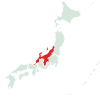
Obuse Town (Nagano)


A Picturesque Chestnut Town Jogging Toward a Greener Future
Just 30 minutes by local train from central Nagano, Obuse has been famed for its chestnuts for centuries. And while this traditional delicacy still drives scores of visitors to the town every autumn, the scenic destination offers diverse ways to connect with both the local community and the natural surroundings whatever the season—whether you choose to take part in a farm experience, explore local residents’ beautifully kept gardens, or simply enjoy some gelato or cheese at a café run by a cattle farmer.
Tasting the Town with A New Generation of Farmers
The ice cream and cheese shop Milgreen is tucked away on the edge of a grove of broadleaf trees by the Matsukawa River, which flows through southern Obuse. Local residents and travelers alike seek out the shop for soft-serve ice cream, artisanal cheeses, and gelato made with local ingredients like the area’s famous chestnuts.

Gelato from Milgreen
The calves traipsing about under the trees just outside in summer are another major draw, says dairy farmer and Obuse native Kinoshita Koya, who runs Milgreen and exemplifies his home town’s tightly knit, forward-looking community. Since setting up his small farm in 2018, Kinoshita has made a point of using local feed and fertilizer, and to make that possible has cultivated ties with other farmers in the area.
For instance, the cornstalks Kinoshita’s cattle graze on come from Kudo Yosuke’s Obuse Meguru Lab nearby. Kudo, a former auto industry engineer who dedicated himself to organic farming in his 30s, grows dozens of different vegetables, as well as apples and peaches, on his compact property. He also educates amateur farmers on organic and sustainable practices, and arranges farm experiences for travelers eager to get a taste of local produce at the source.

Kudo Yosuke at his farm
“In summer, I have visitors who wake up at 6 a.m. to come and harvest corn,” Kudo says, “and in autumn people can pick leafy vegetables and make a salad or sandwich right here in the field.” While participants munch on super-fresh greens, they can strike up conversation with the jovial Kudo, who moved to Obuse after visiting a farmer friend and never looked back. “I really enjoy the small-town feel and community spirit,” he smiles.
Artistic Heritage, Open Gardens, and a Run Through It All
In addition to its produce, Obuse is noted for its association with one of Japan’s greatest artists. Ukiyo-e master Katsushika Hokusai (1760–1849) stayed in the town for several years near the end of his life in the 1840s, residing in the household of a wealthy local farmer. He created several acclaimed works there, some of which are on display at the Hokusai Museum in central Obuse.

Strolling from the museum through the charming town center, you’re sure to come across a number of “Welcome to My Garden” signs. Another example of Obuse’s hospitable vibe, a plaque like this indicates that you’re free to enter and linger in the garden in question, despite it being private property. More than 100 residents have made their gardens available to the public under the town’s Open Gardens initiative, which encourages casual interaction between locals and visitors.

An “open garden” in Obuse
Such friendly exchange is also at the heart of the yearly Obuse Mini Marathon, which sees some 8,000 participants jog through fields, along riverbanks, and down residential roads at the height of summer. At aid stations set up along the route, some residents treat runners to refreshments such as local milk and sweets made from Obuse-grown fruit, while others break out instruments or put on performances to entertain the contenders.
Anyone is welcome to take part in the decidedly casual half marathon; you can sign up online prior tothe event, and many runners make a point of wearing whimsical costumes. Held annually since 2003, the Mini Marathon has become a staple on Obuse’s calendar. It’s also been cited as an outstanding example of sustainable, community-friendly tourism by international authorities such as Green Destinations, which named the Obuse Mini Marathon a Top 100 Good Practice Story in 2023.
Sustainability Spotlight

Hayashi Sho
CEO, SHOCKby Inc.

Shinjo Naoaki
Sustainability Coordinator, Obuse Town
Hayashi Sho and Shinjo Naoaki both moved to Obuse from elsewhere after taking a liking to the vibrant locale and its welcoming disposition. Now, they’re working together to build a sustainable future for the town through a number of community-focused initiatives. Hayashi explains that Obuse has actively attracted outside talent to advance its goals since 2000, when the town enacted a collaboration-focused master plan. “I’ve been involved with Obuse since 2018, when I first visited the town for a youth forum,” he says. “Sustainability, including sustainable tourism, has been at the center of local efforts since 2019.”

Hayashi and Shinjo are especially conscious of making sure that tourism benefits the entire town and its community. Whether it’s through guided tours highlighting local businesses in the central area or farm visits like those offered by Kudo Yosuke, they seek to provide authentic experiences that allow travelers to interact directly with residents and make a constructive contribution to the area. “We’ve found that this form of tourism helps cultivate lasting ties between visitors and the town,” Hayashi says, “and leads to a virtuous circle that brings in new people, further reinforcing the community.”
“We’re aiming to offer travelers the chance to experience daily life in Obuse, no matter what the time of year,” says Shinjo, who hopes to provide even more tangible ways for visitors to make a positive impact on the town. “Many people here are active across the entire town, supporting each other to shape the community. We want to let travelers get a feel for that can-do spirit, too.”
Obuse charms with the friendliness of its people and the beauty of its mountainside scenery. No matter when you visit, you can look forward to a warm welcome and stunning views—and perhaps find a reason to stay longer than expected.
Links