























Sustainable Destinations Connecting with Farmers in Biei and Ome to Experience a New Form of Sustainable Travel
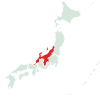
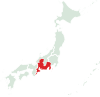
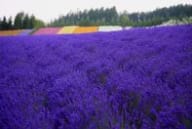
Perhaps you have already heard of—or even visited—the town of Biei in central Hokkaido. This popular destination is beloved for its landscape of rolling hills, characterized by a patchwork of fields ranging from red, yellow, and green to vivid blue and pink. The eye-catching scenery in Biei is composed entirely of active farmland—something that can also be found all around Ome, one of Tokyo’s most rural areas. This bucolic district just outside the big city shares with Biei a focus on agriculture as a catalyst for a new style of sustainable tourism that combines fun and memorable experiences with a forward-looking commitment to the local community.
Biei Town (Hokkaido)


Developing Distinctive, Only-Here Experiences Together with Local Farmers
Recognized as a UNWTO Best Tourism Village, Biei is famed for its ever-changing patchwork hills. This landscape resulted from practical measures, when farmers began rotating crops to maintain the quality of their delicate volcanic soil. The spectacular views created drew many visitors to Biei, particularly in summer when the lavender blooms.
In today’s Biei, local residents have bonded together to develop unique experiences that allow travelers to experience the charm of the area. Tackling tourism-related challenges head on, they invite visitors to enjoy the natural beauty that is an enduring source of pride for the people of Biei.
Cycling Tours
In recent years, local efforts have expanded opportunities to enjoy the scenery of Biei beyond simply taking photographs. Experiences such as cycling excursions and guided farm walks from spring to autumn and snowshoeing in winter provide opportunities for meaningful interactions for local residents and encourage travelers to discover the area at a leisurely pace.
Cycling tours are recommended for all travelers who arrive in Biei, as the relatively flat terrain of the area makes it convenient to explore on two wheels. The patchwork hills can be easily reached by bicycle, while ambitious explorers can ride all the way to attractions such as the Blue Pond or Shirahige-no-Taki Falls near Shirogane Onsen, around 25 kilometers from central Biei. Various outlets in the town center rent bicycles, including e-bikes.

© bieiguide
Traveling by bicycle allows visitors to traverse the hills on local roads, stopping wherever they like and reveling in the scenery.

© Biei Tourism Association
Providing Experiential Opportunities to Meet Local Farmers
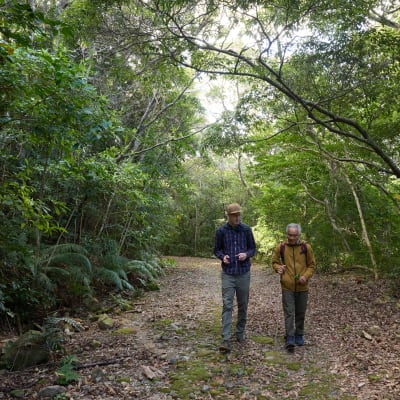
Guided walks across the patchwork hills are another initiative developed by the Biei Tourism Association that brings visitors and local farmers closer together. These walks create personal engagement between travelers and the land itself, opening up discussions on agriculture in Biei, the importance of the industry to the local economy, and farming techniques.

On a guided walk through a snow-covered field
For instance, visitors can learn firsthand about how Hokkaido’s climate differs from other parts of Japan, and how this has led farmers in Biei to focus on hardy crops like potatoes, beans, wheat, and beets. Agriculture is still the primary industry here, with produce from Biei found in supermarkets across the country.
Walking across the fields also inevitably leads to unexpected discoveries and intriguing questions. During our visit in October, we saw large mounds of what looked like dried husks along the roads. Baffled, we learned that these were beets ready to be collected and processed into sugar.
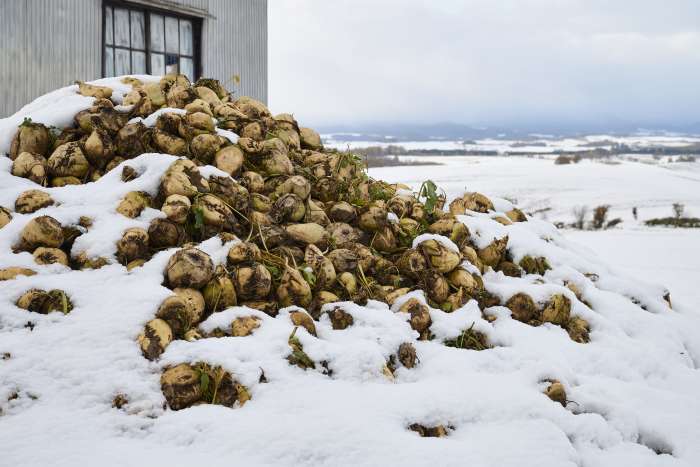
Sugar beets in a snow-covered field in Biei
Winter brings many visitors to Biei for views of the hills blanketed in snow. During the snowy season, the Biei Tourism Association provides snowshoeing tours to explore this winter wonderland. Traversing the vast white fields together with a guide provides a fresh perspective on the iconic scenery while being physically challenging enough to make for a light workout.
Walking or snowshoeing through the famous patchwork hills in the company of a guide doesn’t just make for a memorable experience; it’s also a way to give back to the local community. Part of the tour fees collected go directly to the farmers who make their fields available for guided walks. This additional source of income can play an important role when deciding whether to pass the farm on to the next generation—and thus preserve part of Biei’s iconic landscape.
Walking, cycling, and snowshoeing tours can be booked through the Biei Tourism Association’s website or at the Biei Tourism Center (Shikino Joho Kan) next to the train station. Making reservations in advance is highly recommended, as the tours are small in scale and increasingly popular.
Sustainability Spotlight

Ogura Hiroaki
Master Guide, Biei Tourism Association
Biei remains a quaint destination full of charm, but like any other popular spot, it faces a few tourism-related challenges. Recent years have witnessed traffic and parking issues as well as unwelcome intrusions into farmland.
Most of these issues arise due to a lack of awareness. Visitors to the Patchwork Hills simply do not realize that they are on private property and certainly don’t know that they might be trampling crops.
However, the guides of the Biei Tourism Association, who love nothing more than to share their town with people from around the world, also see these challenges as an opportunity to nudge local tourism in a more sustainable direction.
“We want to cater our tours to each individual,” explains master guide Ogura Hiroaki. “Through conversations, we can offer better experiences that allow people to connect with Biei on a more personal level.”
Ogura hopes to provide more nuanced perspectives on Biei’s famous Patchwork Hills. “I want to showcase the charms of Biei, but also convey the hard work by generations of farmers that led to the creation of its beautiful landscape. Hopefully the tours provided here—walking, cycling, and snowshoeing—will create a future for tourism in Biei that is enjoyable, sustainable, and beneficial for everyone.”

Ogura recognizes that sustainable tourism is all about striking a balance between visitors’ wishes and local residents’ needs. “The key is including as many stakeholders as possible, from farmers and travel companies to local government and businesses,” he says.
One of the world’s Best Tourism Villages, Biei and its resident guides invite you to discover the secrets behind its gorgeous scenery while experiencing local history, culture, and nature—and contributing to their preservation.
In the company of a local guide, you can discover the secrets behind the beauty of Biei's hills, experience the town's history, culture, and stunning natural scenery, and become one of the many people contributing to Biei's sustainable tourism.
Ready to plan a trip to Biei? See the link below for details on available tours, travel tips, manners to keep in mind, and much more.
Links
Ome City (Tokyo)

Hands-On, Near-to-Nature Experiences on the Picturesque Outskirts of a Global Metropolis
In contrast to internet-famous Biei, Ome in rural western Tokyo is what you might call a hidden gem. Most visitors to Japan have no idea that Tokyo is home to mountains, farms, and forests just an hour’s ride by local train from busy Shinjuku. Some intrepid travelers do make the trip to climb Mt. Mitake, known for its sweeping views of the Kanto Plain and ancient mountaintop shrine. Other parts of Ome, like charming little Iwakura with its unique local traditions, healing hot springs, and community-focused farming experiences, are still waiting to be discovered.
Sustainable Farming on Small Farm Plots that Offer Extraordinary Variety
The rich volcanic soils of Ome have long produced superb fruit, including blueberries, persimmon, and yuzu. Green plums cultivated locally for centuries even gave Ome its name. Tea plantations are common sights in the hills and rice fields cluster in precious stretches of flat valley ground.
In recent decades, farmers like Hanjo Tomohiro have been rearing a wider range of crops. As well as common vegetables found in Japanese grocery stores like lettuce, daikon radishes, and green onions, Hanjo also grows cilantro, radicchio, and vegetables like komatsuna that were originally developed in various districts of Edo (present-day Tokyo). All in all, he estimates that he cultivates well over a hundred different types of vegetables.
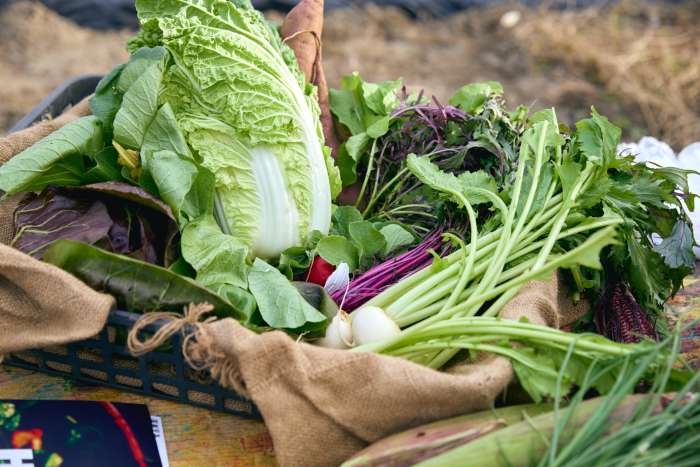
A selection of vegetables grown at Hanjo Farm
Visitors who accompany Hanjo out into the fields as part of the farming experiences he offers will quickly note the remarkable number of small plots in the area. Frequently, multiple crops are planted within the same plot, a sustainable farming practice that keeps the soil healthy and productive for future farmers.

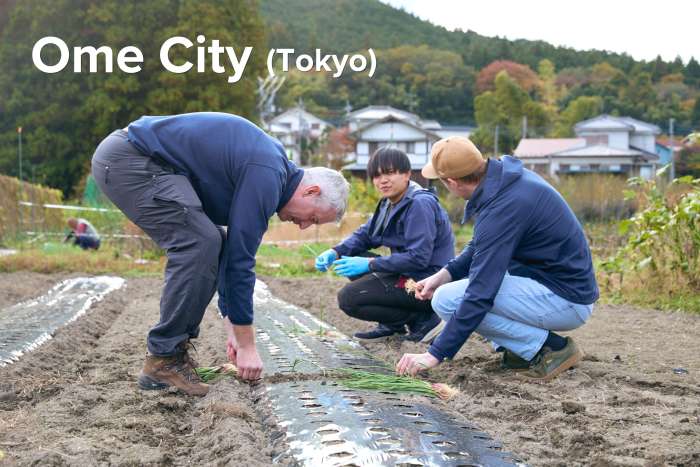
Planting garlic with Hanjo Tomohiro
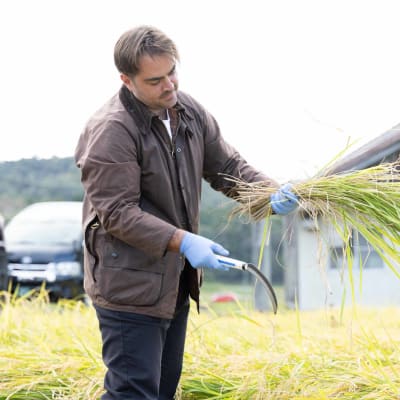
Hanjo believes that the only way to understand farming is to actually put your hands in the dirt. On his tours, participants get directly involved in planting or harvesting different crops, depending on what the season has to offer. We visited Hanjo Farm in late October, prime garlic and onion planting time, and quickly found ourselves pushing moon-shaped cloves and thin green sprouts into the rich brown soil.
An Atmospheric Hot-Spring Inn and a Town Rich in Folklore and Tradition
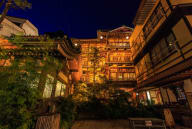
Hot springs are said to have attracted visitors to Iwakura for over a thousand years. Today, however, only a single hot-spring ryokan inn—Mamadaya, built in the nineteenth century—survives in the area. With its earthy wooden interior and traditional Japanese decor, this remarkable building retains a deeply authentic sense of the past in Iwakura.

The Mamadaya inn
Proprietress Mamada Natsumi is the sixth-generation owner of the ryokan. In addition to conveying Mamadaya’s attraction as a historic hot-spring inn, she seeks to preserve and promote the culture and history of Iwakura.

A fusegi waraji in Iwakura
Mamada herself has a wealth of knowledge about the local area. One of the more peculiar traditions in Iwakura that she likes to introduce to visitors is fusegi waraji. These oversized straw sandals are hung in several locations around the village to ward off evil, with malign spirits apparently afraid of any town that has men with big feet.
Guests can also, of course, spend time relaxing in Mamadaya’s hot spring baths. For meals, fresh produce from Hanjo Farm and other local purveyors features prominently, varying pleasantly to reflect the bounty of the seasons. A stay at Mamadaya makes for a comfortable and tasty way to contribute to the Iwakura community and support local farmers.
Rooms at Mamadaya can be reserved via the inn’s official website or the website of Iwakura Experience, an organization founded in 2019 by Ome native Motohashi Daisuke to encourage more travelers from around the world to discover what the area has to offer. Working together with Hanjo Farm, Mamadaya, and others, the organization embodies Ome’s efforts to leverage local agriculture and traditions in promoting sustainable tourism. Thanks to these initiatives, the municipality was recognized under the Japan Sustainable Tourism Standard for Destinations (JSTS-D) in 2023. Reservations for farm experiences and other activities are available on the Iwakura Experience site.
Sustainability Spotlight

Hanjo Tomohiro
Farmer, Hanjo Farm
“You’ll never believe this,” says Hanjo Tomohiro, crouching low as he demonstrates to us city folk how to plant rows of garlic. “I used to work in the vegetables section of a large department store in central Tokyo. They had nice enough vegetables, I guess, but working there—stuck inside all day, dark outside when I left—got depressing after a while.”
Hanjo had long dreamed of becoming a farmer. On days off from his job in the city, he would head out to the countryside for agricultural training sessions. In 2016, he moved to Iwakura and never looked back. Hanjo seems to relish new challenges, rearing everything from standard fare like onions and potatoes to Edo-period (1603–1867) vegetables and exotic pawpaw fruit.

In the end, though, it is the simple pleasures that bring a smile to Hanjo’s face. “It’s such a joy to see young kids take a break from city life and discover where their food comes from. Watching a young person plant their first potato or pull a daikon out of the ground—well, there’s nothing quite like it.”894
Hanjo views farming as a potential bridge between different languages, cultures, and nationalities. “The things we grow, how we grow them, and the meals we make obviously vary, which is endlessly interesting to learn about. But farming itself is universal—something that all human beings intuitively understand.”
Ome is part of Tokyo, yet full of rural charm. Here, local farmers who all grow their own distinctive selections of vegetables invite you to immerse yourself in the area’s natural beauty and experience farm work firsthand. It’s a very different kind of Tokyo, and one just waiting to be discovered.
Links