
















Travel Logs Along the Pilgrim’s Trail in Kagawa


Journey Theme: Uncovering Japan’s most famous pilgrimage and daily local life through the five senses. A journey to savor Kagawa Prefecture through the Shikoku Henro pilgrimage.
Japan is very good at delivering good things in compact packages: miniature menageries of origami; delicate wagashi traditional confectionaries; bonsai trees; the deep contemplation to be discovered within a bowl of tea.
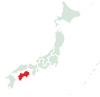
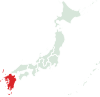
Kagawa, the smallest prefecture in Japan, delivers the essence of Japan in a compact package. Just a 90-minute flight from Tokyo, this area offers a fusion of the epic story of Kukai (Kobo Daishi)—the eighth-century priest who founded Shingon Buddhism—with modern adventure travel.
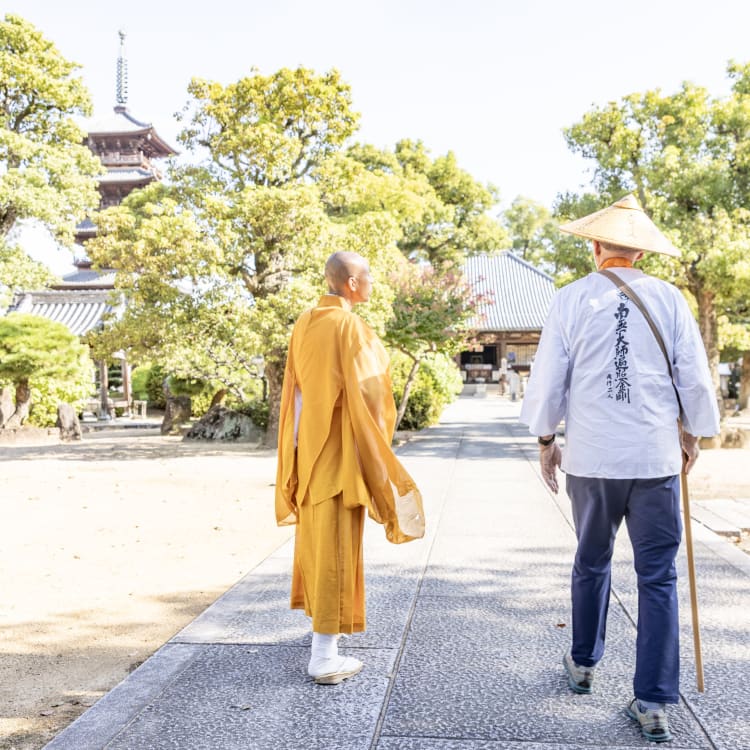
The journey is not just about sightseeing. Kagawa, the home of Kukai, is the climax and final stop of the 1,200-kilometer Shikoku Henro pilgrimage. By donning the white tunic inscribed with the phrase dogyo-ninin (“two traveling together”) and joining the many pilgrims who walk in Kukai’s footsteps, it is possible to become part of 1,200 years of history. The dynamic goma fire ritual and the walk through a pitch-black passageway—representing an unwinding and rebirth—will be soul-stirring experiences quite different from quiet Zen meditation.
A varied landscape of coastal stretches, urban areas, and forested hills define the region. For example, it is from this earth that Aji Stone—Japan’s finest decorative granite—is quarried and fashioned into striking art by skilled craftspeople. After sharpening the five senses through walking the ancient forest trails, travelers can reinvigorate the body with delicious gastronomy, including dishes such as deep-flavored fermented foods and the local specialty of hone tsuki dori (bone-on chicken).
Prayer and craftsmanship, nature and culture—all are densely layered in Kagawa, where deep contemplation and a full-body adventure awaits.
Day 1
My trip starts at Tokyo’s Haneda Airport, for a mid-morning flight to Takamatsu City, the capital and main city of Kagawa prefecture. There I’m met by David Moreton, a Canadian historian, teacher, sometime guide and expert on the Shikoku Henro pilgrimage. Although I’m not here as a pilgrim exactly, he’ll be a great help in understanding what is involved in this religious journey. In fact, he says, “Going to a few temples in a non-chronological order is similar to what most pilgrims do. They’ll visit a few and collect the temple stamps, then maybe come back after months or years to visit a few more.” It’s a long route, but I won’t have to rush through it.
Pilgrims, even casual ones, like to sample the local cuisine, so our first stop is Yamada-ya, an udon restaurant set in an old saké brewery. I order zaru bukkake, a bowl of thick, chewy wheat noodles (known as Sanuki—the old name for Kagawa) udon, with clear, stock-like tsuyu, a variety of toppings to add as desired, and a slice of sudachi, a regional citrus fruit that adds a touch of zest. Starting a trip with one of the local favorite dishes gives a sense of arrival, and it’s exciting to imagine the various experiences ahead of me.


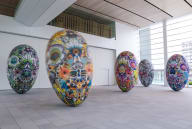
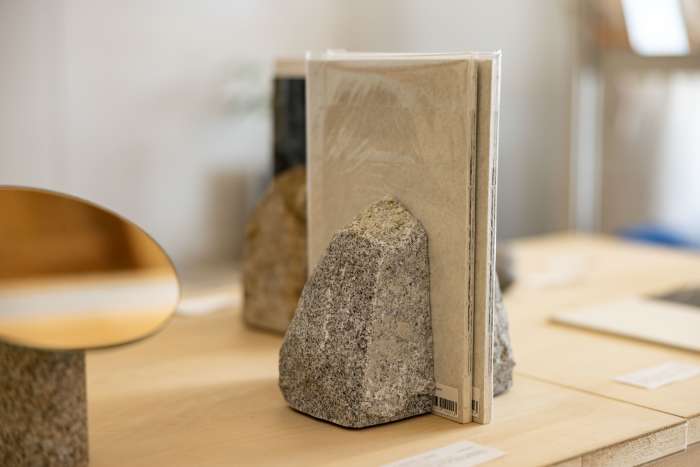
We make the short drive to Mure town, home of the stone production company Aoishima, Inc. The company’s president, Chikara Ninomiya, tells us that Mure is one of Japan’s three major stone producing areas, and that the Aji stone quarried here, a slightly sparkling granite, is one of the finest, and most expensive, stones in the world. Only about five percent of all stone quarried is usable as material for gravestones—the rest is used as gravel, or for landfill.
Mr. Ninomiya has excellent craftspeople, but the market for fine headstones and other high-quality stone products is challenging. So he brought in a group of Japanese and international artists to create innovative designs—smaller, unique and saleable.


(Please note that guests are not normally allowed into the quarry)
He takes us out to the quarry. “Now, pick out a stone without a seam in it,” he says. It’s not an easy task; most of the rocks have fine white lines where the rocks would split when cut and polished. Finally finding one, we take it back to the studio, where it is cut in two, polished on the cut faces but left natural on the outsides. These now sit on my shelf as a pair of bookends.

Now the pilgrimage begins. The first temple visit is to Yakuri-ji, No. 85 on the route. It was founded by Kobo Daishi in 829, and is high up a mountain featuring five whitish granite peaks. Getting there means a ride on a funicular, a cable-drawn tram that gets us swiftly up the steep slope.

The temple’s name means “eight chestnuts,” referring to one of many miracles attributed to Kobo Daishi. It seems he stuck eight roasted chestnuts into the mountain, an offering for success on his China trip. On his return, the roasted chestnuts had miraculously sprouted into trees. It’s a beautiful, quiet temple, with gracefully curved roofs and statues. I get a shu-in, the red stamp with hand-drawn calligraphy that marks my first pilgrimage stop.


Then it’s time for dinner, another Kagawa specialty: hone tsuki dori, chicken thigh butterflied open and still on the bone. I’m given a choice of oya (parent) or hina (chick), the former darker and chewier, the latter softer and whiter. Anyway, both go great with cold beer…. The night in Takamatsu is fun and delicious, but we also need to rest our bodies for tomorrow.


Day 2
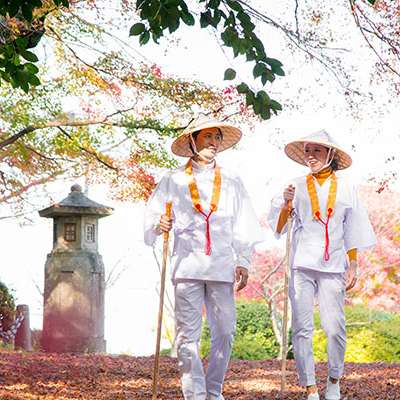
My guide David lends me his henro outfit: a white tunic called hakui or byakue, which symbolizes “a pure mind separated from the world”; a conical straw hat; an orange stole around my neck; a bag containing incense sticks, candles, and lighter; and a long wooden staff called kongo-zue that represents Kobo Daishi. It’s warm, but the hat allows air to flow through, which feels nice. I’m a bit self-conscious, but ready for our first temple visit.


The head priest and his wife greet me at the outer gate of Motoyama-ji, the 70th temple of the pilgrimage. The temple’s Hondo, or main hall, is a National Treasure of Japan, built in 1300 and still retaining 80 percent of the original wood. Next to it is a five-storied pagoda, one of only a few remaining on the trail.

Then we attend goma, one of the key rituals of Shingon. Wooden slats called gomagi, inscribed with the worshipper’s name, age and wish, are burned, symbolic of one wishing for the fulfillment of desires by burning away worldly desires. It’s a dynamic experience. The priest sits on a raised, colorful platform and begins ritual actions as his wife begins to chant—and it’s not quiet. She shouts the words, the priest lights a fire, she begins to beat on a taiko drum while chanting, then blows on a giant shell horn as the fires leap up.
It’s quite mesmerizing. Following instructions, I move to the left side of the altar; using tongs, I place a ruler-sized piece of wood with my wish, name and age on it into the fire.
After a bow to the Buddha statute behind the altar, I return to my seat feeling a bit buzzed by it all. It was partly the crackling fire and smoke, the ritual actions of the priest, and the intensity of his wife’s chants. But it was also the idea of my wish being lifted in the rising flames, and a feeling of being more closely connected with these ancient rituals, and surrendering to sensory overload! I felt a sense of purification, as well as of having stepped into a completely new world.
Afterwards, the priest takes me up into the five-story pagoda, which was recently renovated (note that this was a special opportunity; prior permission is required to go into the pagoda).

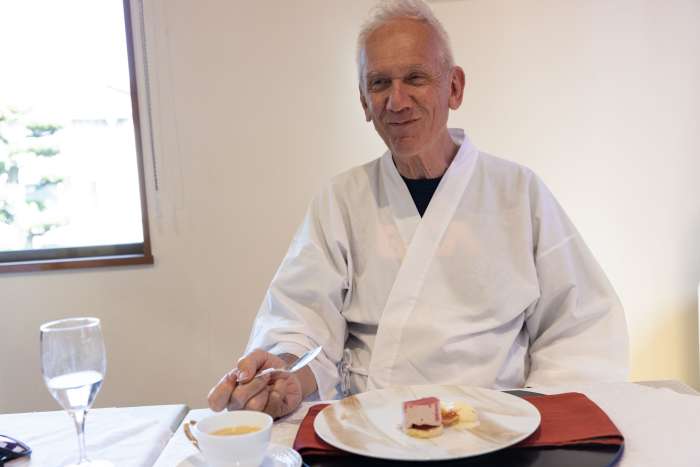
At Le Paysan restaurant, lunch is a meeting of fine French food and shojin ryori, traditional vegetable food developed by Buddhist monks. It’s beautifully prepared, and delicious, with the staff and chef explaining the origin of all the ingredients.


The chef also explains the importance of fermentation in Japanese cooking compared to its use in Western cuisine. And, yes, Kobo Daishi gets a mention here, too, as an early pioneer of microbiological cooking. The food was a modern interpretation, but I felt a connection to the gastronomic roots of Kagawa cooking and the health benefits I was gaining through the delicious meal.
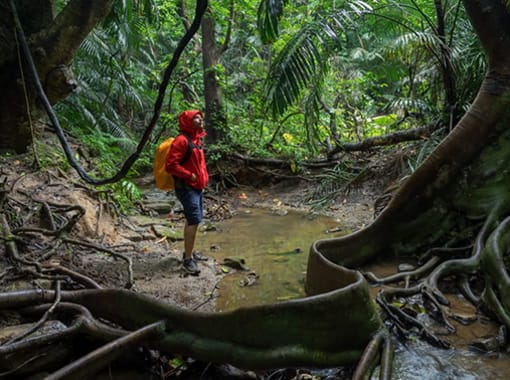
Three temples are on our afternoon route. Number 82, Negoro-ji, is up a mountain in a wooded setting selected by Kobo Daishi. After a quick look at the stairways climbing up through the forest, we head in the opposite direction and do the pilgrimage the old-fashioned way, hiking along a forest trail to temple number 81, Shiromine-ji. In today’s modern world, much of the Shikoku Henro is on paved roads and city streets; here, it’s more like a hike along a mountain trail. It winds through forests that are deep and quiet, with just the sounds of jays, crows and small songbirds around us.
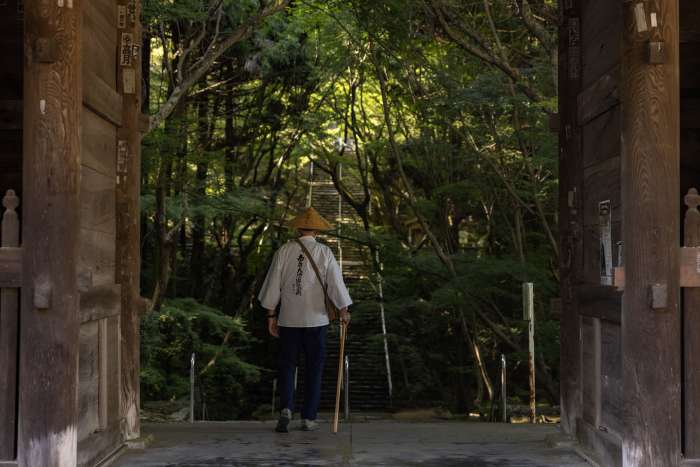

I think about the traditional pilgrims in straw sandals, because the trail can be steep in sections, and after a few kilometers of continuous descent the knees can get a bit warm. Occasionally an ancient stone sign-pillar appears, often oddly enough with the engraving of a fairly modern-looking pointing finger to show that we’re going in the right direction. Black-and-white hotaru ga (pidoris glaucopis), striking moths with orange heads and long feathery antennae, are our constant companions, fluttering around the trail. I’m starting to feel the part in my pilgrim outfit, especially out here on the trail. The journey has become a real adventure, and I’m really feeling the flow of time as I think about all the feet that have traced this route ahead of me.


After getting my shu-in stamp, we drive to Zentsu-ji, temple number 75. This is the birthplace of Kobo Daishi, and where we’ll stay tonight. It is one of three great sacred sites associated with Kobo Daishi, and contains several historic sites related to his childhood. This is also part of the pilgrimage; we’ll share the quite spacious facilities of the shukubo, or temple lodging, with several other pilgrims, and take in an early-morning ceremony as part of the training. The head priest meets us and gives a quick introduction. “The number of pilgrims has really fallen off after Covid,” he says, “but lately we’ve been getting more guests, especially from Northern Europe.” After a shojin ryori dinner, it’s early to bed. Enveloped in the silence of the shukubo, getting ready to sleep in my futon on the tatami mats, I think of all the pilgrims who have rested here over the centuries in Kobo Daishi’s home. I feel the flow of time, but also a better connection with that remarkable priest of the past.
Day 3
The day at the shukubo starts with a 6am ceremony. A shaven-headed priestess passes out the words of the chant, and the ceremony begins. The head priest says a few words about Kobo Daishi and the pilgrimage; the priests chant, both as a group and solo, strike gongs and drums while the head priest works through the rituals of Shingon at the altar.


We then are led to find our way through a pitch-black passageway that leads in a counterclockwise direction under the hall. This, a kind priest explains, represents an unwinding, a rebirth. His words really took hold with me, as did the warmth in which he spoke with us. I felt this was an opportunity not to be lost, a good moment to reset my life and think about new possibilities.


I’m back in my civilian clothes for our next trip, which takes us up Japan’s fastest aerial tram to Unpen-ji, temple number 66. At 927 meters, it is the highest temple of the pilgrimage. We’re joined by Hiroshi Matsumoto, an official guide in full pilgrim gear. He and David provide a wealth of information about the temple, about Kobo Daishi, the history of the area.

Just as we leave the temple, I’m fascinated by something I also saw at Zentsu-ji: statues of 500 rakan, people who have reached enlightenment. They’re almost comical with exaggerated faces, beards, and hats. Unlike otherworldly Buddha figures, Matsumoto says, these are a reminder that normal people can find enlightenment, a concept that is found in the kanji (Chinese characters) for Shingon.


Then we hike, heading down from the summit on a long, steep forest trail that again gets us way out into nature (and we meet no one else, apart from those fluttering moths and big, but harmless, joro spiders in their spreading webs).

At the Nakano Udon School in the town of Kotohira, I learn first-hand about those chewy Sanuki udon noodles I had a few days ago. My chef and guide gives me an apron and vinyl gloves, then gets me mixing salt water and flour vigorously until it’s slightly yellow and cohesive. The dough goes into a bag, and I’m told to take off my shoes and begin to knead the dough with my feet.

Accompanied by disco music and tambourines helpfully wielded by bystanders, I dutifully work the dough. The elastic result is rolled out, cut into three-millimeters strips, and then cooked. Delicious, and I got a roller pin and a diploma as well. Making Kagawa’s soul food—those noodles that I enjoyed at the start of this journey—was a new experience. In fact, I was so pleased with my first try that I have since taken my well-won recipe and roller and created Sanuki udon for my family and friends.


Feeling pleased with my culinary work, we head off for a climb up the 785 steps leading up to Konpira-san, a Shinto shrine. This is an ancient place, perhaps dating back to the first century.

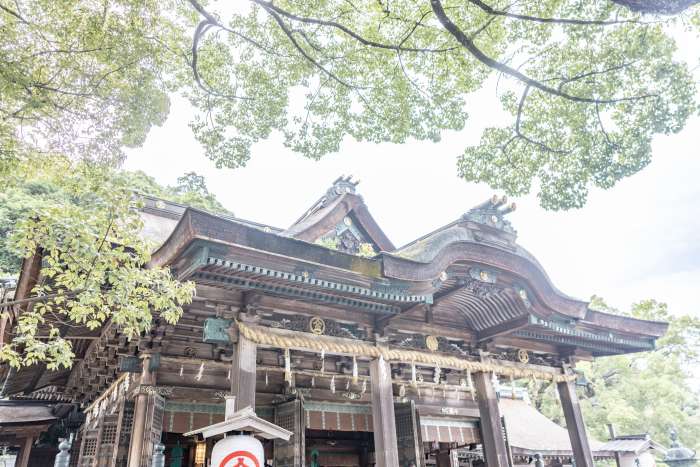
One of the priests describes the buildings and points out some stunning views of the ocean and Sanuki Fuji, a perfect conical mountain in the distance. The gates along the path and the main shrine have beautiful, curving roofs covered in cypress bark. The first character of the shrine’s name means gold, and we purchase a gold omamori, an amulet that promises happiness and good fortune.


Finally, we visit Lake Manno, the largest reservoir in Japan. Kagawa doesn’t have any major rivers, so providing enough water for rice irrigation has always been a problem. An ancient dam that had been built to create the lake ruptured, so in 821, just three years later, Kobo Daishi was sent to oversee the reconstruction. It turns out that was another of his skills, along with temple construction and setting up a religious sect.


The peaceful stop at the lake is an ideal ending to the journey before making my way back to the airport for the flight back to Tokyo. I’m a bit overwhelmed from the many new experiences, but happy. Many of the experiences, I know, will remain with me forever. I enjoyed wearing the henro outfit, and found I liked fitting in with other hikers on the ancient trail. As I often discover in Japan, there’s so much to do—even in small areas. Scratch the surface and you’ll find so much history and culture and great tastes and kind people to take in that you realize that long treks aren’t necessary to find amazing things. That said, having done six of the 88 temples of the Shikoku Henro pilgrimage I may someday find myself wanting to travel further down Kobo Daishi’s trail. My personal henro diary still has empty pages that need to be filled in the future.
Links
Anabuki Travel(Guiding and Tour Coordination)