










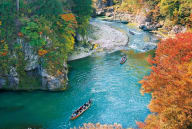











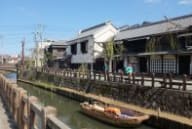














Korakuen, Okayama (Okayama Prefecture). (Credit: ©Okayama Prefectural Tourism Federation)
Sydney, Australia (22 October, 2025): Across Japan, gardens are living expressions of harmony where nature, artistry, and tradition come together in perfect balance. From central and western Japan to the subtropical islands of Okinawa, Japan’s regional gardens invite visitors to slow down and experience the country’s enduring connection to the seasons.
Each garden tells its own story of craftsmanship and contemplation, reflecting centuries of design philosophy shaped by place and culture.
“Japan’s gardens offer travellers a chance to experience the country’s deep respect for nature and design in its purest form,” says Naoki Kitazawa, Executive Director of the Sydney Office Japan National Tourism Organization (JNTO). “From celebrated city gardens to remarkable landscapes found throughout regional Japan, these destinations reflect the heart of local culture and invite visitors to connect with Japan’s natural rhythm throughout the seasons.”
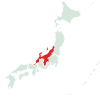
Kenrokuen  , Kanazawa (Ishikawa Prefecture)
Celebrated as one of Japan’s Three Great Gardens, Kenrokuen embodies six essential qualities of landscape beauty - spaciousness, seclusion, artifice, antiquity, water and scenic views. Created in the 17th century by the Maeda Clan, lords of the Kaga Domain, the garden surrounds the former Kanazawa Castle and was once reserved for samurai and nobility. Today, its meandering paths, teahouses and stone lanterns frame seasonal highlights, from plum and cherry blossoms in spring to irises and maples in summer and autumn. In winter, elegant yukitsuri ropes protect the garden’s pine trees from snow, creating one of Japan’s most picturesque seasonal scenes.
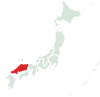
Korakuen , Okayama (Okayama Prefecture)
A masterpiece of Edo Period design, Korakuen combines sweeping lawns, tranquil ponds and teahouses framed by Okayama Castle. Completed in 1700 by the Ikeda Clan, the garden was designed for both relaxation and ceremony, embodying the concept of senyu koraku - finding pleasure after duty. Visitors can follow winding paths past lotus ponds and maple groves, watch herons wade through the streams or enjoy matcha in the Enyotei teahouse overlooking the central lawn. In every season, from cherry blossoms to autumn foliage, Korakuen captures the changing spirit of Japan’s landscape.
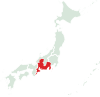
Saihoji Temple , Kyoto (Kyoto Prefecture)
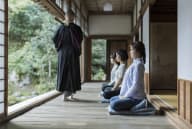
Also known as Kokedera or the ‘Moss Temple’, the UNESCO World Heritage-listed Saihoji Temple is said to have been founded in 731 before being restored by priest Muso Kokushi to become a Zen temple in 1339. Today, visitors can meander through the mystical, mossy grounds and see the heart-shaped pond, three islands named Sunrise, Sunset and Mist, as well as stone arrangements which have remained intact for more than 680 years. Visitors must reserve their visit in advance to explore the grounds and participate in activities including morning zazen meditation sessions or calming sutra-copying workshops, with bookings opening two months ahead. Visit during the June rainy season to experience Saihoji at its most lush.
Kairakuen , Mito (Ibaraki Prefecture)
Known for its spectacular plum blossom festival each February and March, Kairakuen is another of Japan’s Three Great Gardens, and uniquely, one that was created for public enjoyment. Established in 1842 by Tokugawa Nariaki, a local lord of the Mito Domain, it reflects an unusually inclusive philosophy: that beauty should be shared by all. The garden’s 3,000 plum trees bloom in shades of white and pink, filling the air with fragrance, while bamboo groves, cedar forests and open lawns invite year-round strolling. Together with the nearby Kodokan Mito Domain School and Lake Senba, Kairakuen forms part of a vast scenic parkland that celebrates harmony between nature and people.
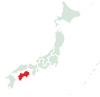
Ritsurin Garden , Takamatsu (Kagawa Prefecture)
One of Japan’s largest and most exquisite historical gardens, Ritsurin spans more than 75 hectares and took over a century to complete. Once the private retreat of feudal lords, its six ponds, 13 landscaped hills and more than a thousand pine trees were carefully arranged to highlight the backdrop of Mt Shiun. The garden’s name, meaning “chestnut grove,” hints at its natural abundance. Visitors can enjoy a traditional boat ride across the ponds, pause for tea at the Kikugetsutei teahouse, or explore the Sanuki Folk Craft Museum on-site. Each visit reveals a new perspective, from azaleas in spring to lotus blossoms in summer and brilliant maples in autumn.
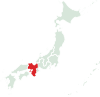
Isuien Garden , Nara (Nara Prefecture)
Nestled near Todaiji Temple and Nara Park, Isuien offers an oasis of calm in the city’s historic heart. Its name translates to “garden founded on water,” referring to the Yoshiki River that feeds its central ponds. The garden consists of two sections, one from the Edo Period and another from the Meiji Period, which blend seamlessly through the use of shakkei (borrowed scenery). Distant temples and hills are framed as part of the view, adding depth and serenity to the overall composition. Visitors can enjoy matcha at the Sanshutei teahouse, surrounded by carp ponds and stone lanterns that embody the tranquility of Nara.
Yuushien Garden , Matsue (Shimane Prefecture)
Situated on Daikon Island, Yuushien is celebrated for its spectacular peony displays, which bloom year-round thanks to the garden’s temperature-controlled greenhouses. Opened in 1975, it reflects the artistry of Izumo-style landscaping with waterfalls, stone bridges and moss gardens arranged around a large central pond. Beyond its famed peonies, seasonal flowers such as irises and hydrangeas create an ever-changing palette of colour. The garden also offers a café, peony-cutting demonstrations and night illuminations that make Yuushien one of Shimane’s most enchanting horticultural attractions.
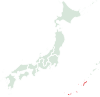
Shikinaen , Naha (Okinawa Prefecture)
A part of a UNESCO World Heritage site, Shikinaen was once a villa of the Ryukyu royal family and a retreat for welcoming Chinese envoys and hosting cultural ceremonies. Completed in the late 18th century, it showcases a fusion of Japanese, Chinese and Okinawan influences, with red-tiled wooden pavilions, arched stone bridges and circular walking paths surrounding a reflective pond. The garden’s subtropical flora, including banyan and palm trees, create a distinct southern atmosphere unlike any mainland garden. Just minutes from central Naha, Shikinaen offers a tranquil glimpse into Okinawa’s royal past and enduring island heritage.
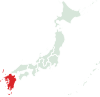
Nokonoshima Island Park , Nokonoshima Island (Fukuoka Prefecture)
A short ferry ride from Fukuoka City in Hakata Bay, Nokonoshima Island Park is the crown jewel of Nokonoshima Island. Famed for its magnificent seasonal displays, visitors can combine meandering through the blooms with the opportunity to sample fresh fruit from local farms and the popular local Noko Burger. The most iconic display is the approximately 30,000 cosmos which bloom in autumn, but every season has a vibrant new story to tell, including daffodils in winter, a yellow carpet of nanohana canola blossoms during springtime, and stunning sunflowers and scarlet sage during the summer.
Ryoanji Temple Rock Garden, Kyoto (Kyoto Prefecture)
Believed to have been created at the end of the Muromachi Period, around 1500, the UNESCO World Heritage-listed Ryoanji Temple is home to one of Kyoto’s most famous yet deceptively simple gardens. Featuring a layout of just 15 stones of various sizes atop gravel in an intimate space of approximately 250 square metres, the meaning behind the garden’s design remains a mystery, although popular theories include that it represents islands in an ocean, mountains amidst the clouds or a tigress and her cubs crossing a river. Fun fact: the 15 stones are cleverly arranged so that one is always hidden from view, no matter where the visitor stands to signify the fact nobody is perfect (the number 15 represents perfection) and the human perspective is limited.
- Ends -
For additional information or image requests, please contact:
Anne Wild & Associates – JNTO’s PR Representatives in Australia
Emily Watters, Senior Account Manager
ewatters@awassociates.com.au +61 449 506 064
