






















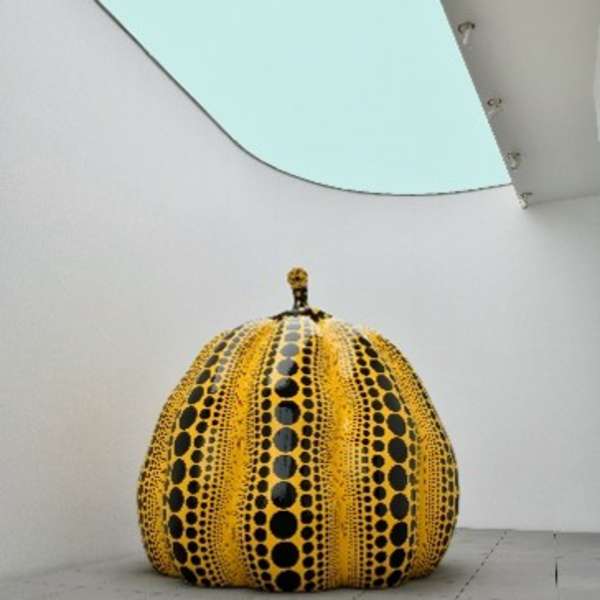
Yayoi Kusama, Great Gigantic Pumpkin, 2024. ©YAYOI KUSAMA.
Sydney, Australia – 20 October 2026: Discover the places behind the life and legacy of Yayoi Kusama, following the passing of the internationally celebrated artist at the age of 97. Kusama died in Tokyo on 14 August 2026, bringing to a close an extraordinary seven-decade career that transformed polka dots, pumpkins, mirrors and repetition into one of the world’s most recognisable artistic languages.
As one of Japan’s most celebrated contemporary artists, her unique work can be appreciated across the country in museums and within the Japanese landscape. Travellers can explore the places that shaped Kusama’s life – and encounter her iconic works from Matsumoto to Tokyo.
Begin the journey where Kusama was born, in her hometown of Matsumoto, Nagano Prefecture in 1929. She grew up here and began painting as a child, developing her early artistic abilities that would be the foundation of her career. The Matsumoto City Museum of Art  has an extensive collection of her work and visitors are greeted by The Visionary Flowers, a towering installation of brightly coloured tulips. There is a dedicated, year-round Kusama exhibition, currently covering her artistic journey from her early Matsumoto works through to pieces from her vibrant, large-scale My Eternal Soul paintings, filled with recurring faces, eyes, and colourful abstract forms.
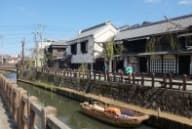
While in Matsumoto explore the historic Matsumoto Castle, Nakamachi and Nawate shopping streets for small galleries, Edo period merchant buildings, craft shops, cafes, sake breweries and the imposing Japan Alps that surround the city.
From Matsumoto, Kusama moved to Kyoto in 1948, where she studied Japanese-style painting at the Kyoto Municipal School of Arts and Crafts before developing the distinctive visual language that would eventually take her to New York. Today, visitors can see her work in the collection of the National Museum of Modern Art, Kyoto , including the 1964 mixed-media sculpture Travelling Life. Kyoto inspires today, a city that celebrates creative beauty, from shining gold pavilions to quiet bamboo groves and the bright Fushimi Inari Shrine.
From Kyoto, Kusama moved to the US in 1957 to establish herself in New York’s avant-garde art scene, returning to Tokyo in 1973 where she continued to write fiction, poetry, created outdoor sculptures, large-scale installations and the Infinity Mirror Room series. She established her studio in Shinjuku, Tokyo until her death.
In 2009 she began working on her My Eternal Soul series. Opened in 2017, the Yayoi Kusama Museum in Shinjuku offers an immersive encounter with the artist’s work and reopened on 8 October with a new exhibition, The Light Spreads Out, and Glittering Things Start Appearing All Around Me. As the museum does not have a permanent exhibition, the works on display change from exhibition to exhibition; timed tickets can be purchased only through the museum’s website, with no tickets available at the door.
The National Museum of Modern Art, Tokyo also holds Kusama works including Accumulation of the Corpses (Prisoner Surrounded by the Curtain of Depersonalization) (1950) and No. H. Red (1961), placing Kusama firmly within the history of modern Japanese art.
On Naoshima, a small island in Japan’s Seto Inland Sea in Kagawa Prefecture, now known as one of the country’s leading contemporary art destinations, Kusama’s art became part of the landscape itself. In 1994 she was invited to create a work for Open Air ‘94 ‘Out of Bounds’, an exhibition that brought contemporary art into the natural environment of the Seto Inland Sea. The famous yellow-and-black polka-dot Pumpkin was designed specifically for its setting, on a pier jutting into the sea. Originally intended as a temporary installation, the yellow Pumpkin was retained as a permanent work, helping establish Naoshima’s now-famous philosophy of bringing together art, architecture and nature. Today, Kusama’s work remains part of the island experience, alongside her Red Pumpkin at Miyanoura Port and Narcissus Garden an installation of mirrored spheres.
Travellers are invited to see where Kusama’s outdoor pumpkin sculptures began in Fukuoka City. Before Kusama’s pumpkins became global icons, her first sculpture appeared at Fukuoka Art Museum in Fukuoka City in 1994, attracting enormous public attention and transforming the cityscape. According to the museum it first appeared in front of a bank in Fukuoka’s Tenjin district as part of Museum City Tenjin ‘94, before entering the museum’s collection in 1996. It is now displayed in the museum’s outdoor Esplanade.
Here are six additional spots to spot Kusama’s iconic works across Japan –
- Visit the Tokyo Metropolitan Government Building (South Observatory) to see a bright yellow piano named Omoide (memory) piano, gifted by Kusama covered in her signature polkadots. The piano is played by visitors to the building.
- The KURKKU FIELDS in Kisarazu, Chiba
 combines organic farming, food, nature and contemporary art with Kusama’s Guidepost to the New World a cluster of polka-dot forms set among the fields and Time Goes By, Death Approaches from her Eternal Soul series, displayed inside the FLACC building.
- Kirishima Open Air Museum has 23 large-scale sculptures scattered across forest and grass. Kusama has two sculptures featured - Red Shoes and Flowers of Shangri-la a massive polka-dotted flower sculpture.
- Yellow polka dots decorate the lawn of Art Square at Towada Art Center in Towada, Aomori, beneath eight colourful Kusama sculptures of a pumpkin, girl, dogs and mushrooms that form Love Forever, Singing in Towada, a permanent outdoor installation created in 2010. Towada is currently running a memorial program Kusama Forever 1929-2026 until December 2026.
- At Hara Museum ARC in Gunma , visitors can step into Kusama’s Mirror Room (Pumpkin) (1991/1992), a two-metre mirrored cube containing a yellow, polka-dot pumpkin that appears to multiply into infinity – a work Kusama reportedly described as ‘truly my representative work’ and which was later exhibited at the 1993 Venice Biennale.
Kusama dedicated her life to artistic creation, pursuing an internationally acclaimed career as a pioneering avant-garde artist whose practice spanned visual art, performance, fiction and poetry. Today visitors can celebrate her extraordinary legacy through works displayed indoors and outdoors across Japan.
For more information and inspiration, visit www.japan.travel/en/au
-ENDS-
For media enquiries contact: jnto@gtitourism.com.au
About JNTO
Japan National Tourism Organization (JNTO) is a government body whose aim is to promote Japan internationally as both a leisure and business travel destination through the themes of Adventure, Travel, Sustainable Tourism, and Luxury Travel. JNTO has 26 international offices and is the ultimate resource for travel-related information on Japan. Sydney Office, Japan National Tourism Organization (JNTO) services Australia, New Zealand, and the Pacific region.
